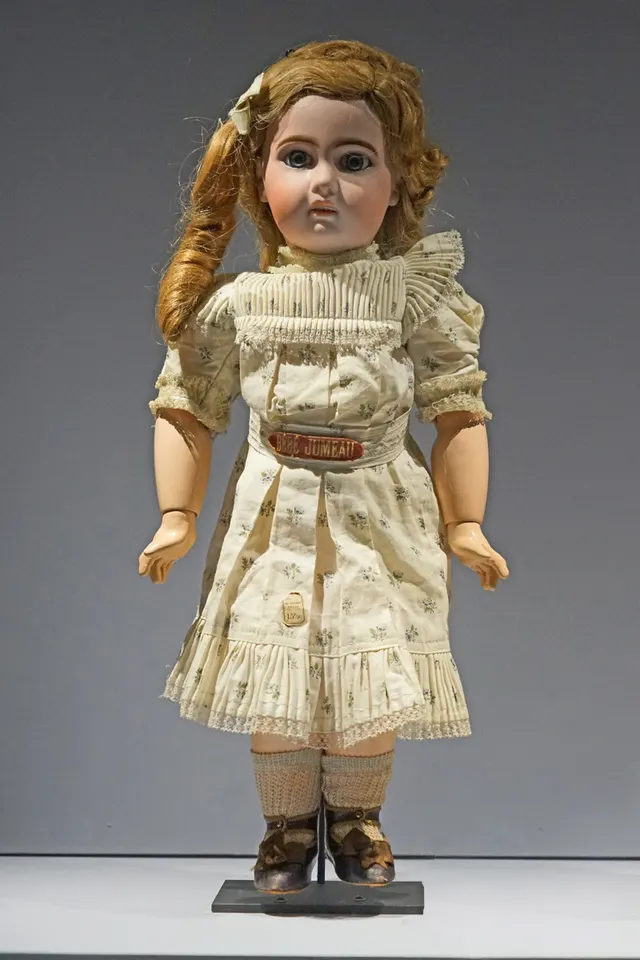
For much of the nineteenth century, the finest dolls in the world came from a handful of workshops in Germany and France. Their bisque — unglazed porcelain with a soft, skin-like finish — set a standard of beauty and craft that has never quite been equalled, and their dolls remain among the most collected antiques of all.
The bisque golden age
Bisque dolls reached their peak between about 1860 and 1900. The head was moulded from fine porcelain and fired at over 1,260 °C, then painted and re-fired layer by layer to build lifelike skin tones and features, with set glass eyes and real-hair or mohair wigs. Collectors distinguish bisque (unglazed, matte) from glazed china heads and from untinted white parian.
The French bébés
France’s great houses — Jumeau, Bru, Steiner and Gaultier — led the luxury market from the 1860s to the 1880s with the bébé: a doll modelled as a real child rather than a fashionable adult, with an exquisite couturier wardrobe. As cheaper German dolls captured the market in the 1890s, the French makers banded together as the consortium S.F.B.J. (Société Française de Fabrication de Bébés et Jouets) in 1899.
The German workshops
Germany’s doll industry, centred on the clay-rich region of Thuringia and the toy towns of Sonneberg and Nuremberg, produced enormous quantities of fine dolls. Names still revered by collectors include Simon & Halbig (founded 1869 in Gräfenhain, and supplier of heads to the best makers across Europe), Kestner, Armand Marseille and Kämmer & Reinhardt, whose “character” dolls modelled real children’s expressions.
Collecting today
Antique bisque dolls are among the most valuable of collectibles, sometimes worth many thousands. Identification turns on the incised marks on the back of the head — the maker, mould number and size — together with the material, eyes and body construction, which together date and place a doll.
Frequently asked questions
What is a bisque doll?
A bisque doll has a head of unglazed porcelain with a soft, matte, skin-like finish, fired above 1,260 °C and painted in layers. Bisque dolls reached their peak between about 1860 and 1900.
What is a bébé doll?
A bébé is a 19th-century French doll modelled as a young child rather than a fashionable adult woman — pioneered by houses such as Jumeau and Bru with elaborate couturier wardrobes.
Sources & further reading
Written in our own words from the references above and other reputable sources. Cultural traditions vary locally and scholarship evolves; corrections are welcome via our contact page.