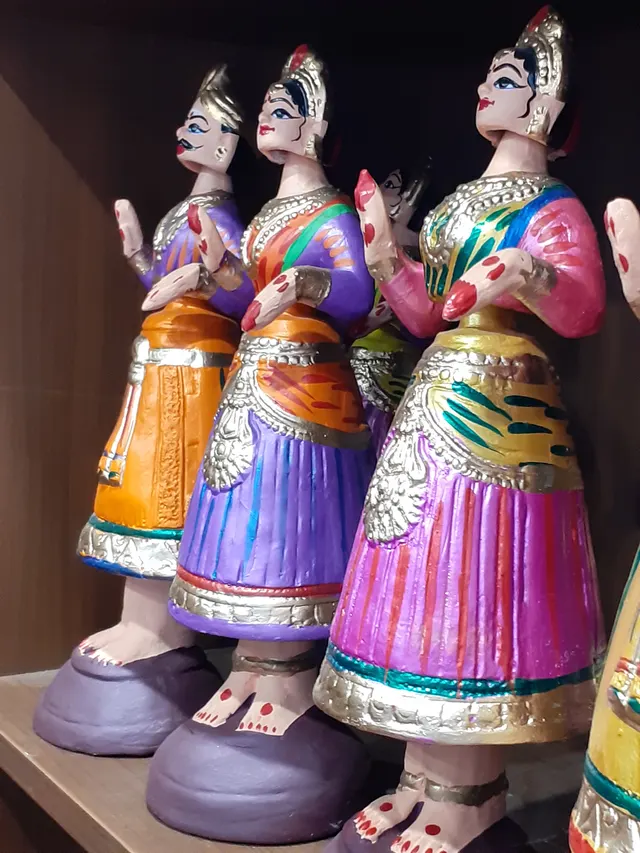
India makes dolls the way it does everything: in dazzling regional variety. From tiered festival displays to lathe-turned lacquer toys and gently nodding bobble-heads, Indian dolls are woven into worship, play and craft economies that are centuries old. The Hindi word gudiya and the Bengali word putul both simply mean “doll.”
Golu — the festival of dolls
During Navaratri, families across South India arrange Golu (also Bommai Kolu or Gombe Habba): a display of dolls and figurines on an odd number of tiered steps. The arrangement tells stories — gods and goddesses, scenes of court and village life, weddings, processions and miniature kitchens — and neighbours visit to admire one another’s displays.
At the very top stand the Marapachi bommai, a pair of human figures traditionally carved from red sandalwood or teak, handed down through generations as the heart of the family’s collection.
Channapatna — the toy town of Karnataka
Between Bengaluru and Mysuru lies Channapatna, famous enough to be called simply “Toy Town.” Its makers turn soft ivory-wood (aale mara) on a lathe and finish it with natural lacquer and vegetable dyes, giving glossy, child-safe toys and dolls. The craft is said to date to the era of Tipu Sultan and is protected today as a Geographical Indication.
Kondapalli — carved village life
From the town of Kondapalli near Vijayawada in Andhra Pradesh come lightweight wooden figures carved from the soft Tella Poniki wood. Kondapalli dolls depict gods and goddesses, animals, and above all everyday village characters — the bullock cart, the dancer, the vegetable seller — painted in bright natural colours for the Golu.
Thanjavur thalaiyatti bommai — the dancing dolls
The Thanjavur thalaiyatti bommai of Tamil Nadu are the beloved “head-shaking” dolls: made of terracotta, clay, plaster or papier-mâché and balanced so the head and torso rock and nod with the gentlest touch. They were granted a Geographical Indication in 2008.
Beyond the south: Bengal, Assam & the north
Eastern India is a treasury of dolls. The Krishnanagar clay dolls of Ghurni (Nadia, West Bengal) are famous for their astonishing, lifelike realism — a roughly 250-year-old art nurtured by royal patronage. Nearby, the village of Natungram in Purba Bardhaman is known as the “village of dolls,” where Sutradhar families carve brightly painted wooden owls, kings and queens, and figures of Gaur–Nitai from white teak.
In Assam, the Asharikandi potters shape a special hiramati clay into terracotta figures — above all the iconic Hatima Putul, a mother-and-child form with elephant-like ears. From Bihar come dolls woven of golden sikki grass, from Tirupati the paired dampati (husband-and-wife) dolls, and from Rajasthan the vivid cloth figures of the kathputli puppet tradition.
Gudiya & the doll weddings
Beyond the festival dolls, children across India play at doll weddings (gudiya-gudda ka byah), staging a full marriage between a bride and groom doll with tiny finery, music and feasting — rehearsing the community’s grandest ritual in miniature.
Frequently asked questions
What is Golu during Navaratri?
Golu (also Bommai Kolu) is a South Indian festival display of dolls arranged on an odd number of tiered steps during Navaratri, depicting gods, court and village life, weddings and processions.
What are Channapatna toys made of?
Channapatna toys from Karnataka are turned from soft ivory-wood on a lathe and finished with natural lacquer and vegetable dyes, making them glossy and child-safe. The craft is protected as a Geographical Indication.
What are Thanjavur dancing dolls?
Thanjavur thalaiyatti bommai are Tamil Nadu’s “head-shaking” bobble-head dolls, made of terracotta, clay or papier-mâché and balanced so the head nods at a touch. They received a Geographical Indication in 2008.
Sources & further reading
Written in our own words from the references above and other reputable sources. Cultural traditions vary locally and scholarship evolves; corrections are welcome via our contact page.