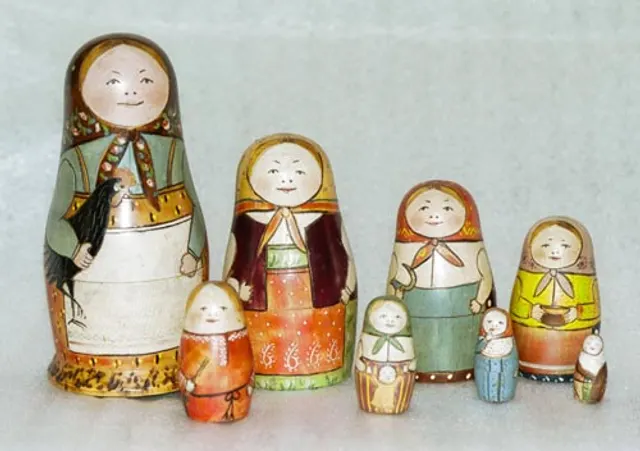
No doll says “Russia” like the matryoshka — the set of hollow wooden figures that open to reveal a smaller doll, and a smaller one, and a smaller one still. It feels ancient, but it is surprisingly modern, and its story reaches all the way to Japan.
The birth of the matryoshka
The first Russian nesting doll set was made in the 1890s, turned on a lathe by the craftsman Vasily Zvyozdochkin from a design by the folk-art painter Sergey Malyutin, at the Abramtsevo estate near Moscow — a hub of the Russian arts-and-crafts revival.
Its inspiration appears to have been partly Japanese: a set of nesting figures of the sage Fukuruma is often cited as a model, and one such figure is kept today in the Sergiev Posad Museum of Toys. In 1900 a set of matryoshkas was shown at the Exposition Universelle in Paris, where it won a bronze medal and launched the doll’s international fame.
Sergiev Posad & Semyonov
Production quickly settled in Russia’s great toy-making centres, above all Sergiev Posad and the town of Semyonov, each developing its own painting style — from realistic peasant women in headscarves to the bold, blazing floral “Semyonov” style with its large bouquet across the apron.
A family within a family
The name matryoshka evokes mat’, “mother.” The doll is widely read as a symbol of motherhood, fertility and the continuity of generations — a whole family gathered inside a single figure. The very smallest doll, solid and unopenable, is often the emotional heart of the set.
Motanka — the faceless thread doll
Older than the matryoshka is the Slavic motanka (from Ukraine and across the region): a doll wound entirely from thread and cloth with no needle and no drawn face. Faceless by design — a face, it was believed, might invite a spirit to enter — the motanka served as a household guardian and a charm for protection and fertility.
Frequently asked questions
What does a matryoshka doll symbolise?
The Russian matryoshka — a set of wooden dolls nested one inside another — symbolises motherhood, fertility and the continuity of generations: a whole family gathered inside a single figure.
When was the first matryoshka made?
The first Russian nesting doll was made in the 1890s, turned by Vasily Zvyozdochkin from a design by Sergey Malyutin. It won a bronze medal at the 1900 Paris Exposition.
Sources & further reading
Written in our own words from the references above and other reputable sources. Cultural traditions vary locally and scholarship evolves; corrections are welcome via our contact page.