The dolls of North America span an extraordinary range: on one hand, the sacred carved figures of the Pueblo peoples, made to teach children the spirit world; on the other, the mass-produced characters — Kewpie, Raggedy Ann, Barbie — that became worldwide icons of the twentieth century.
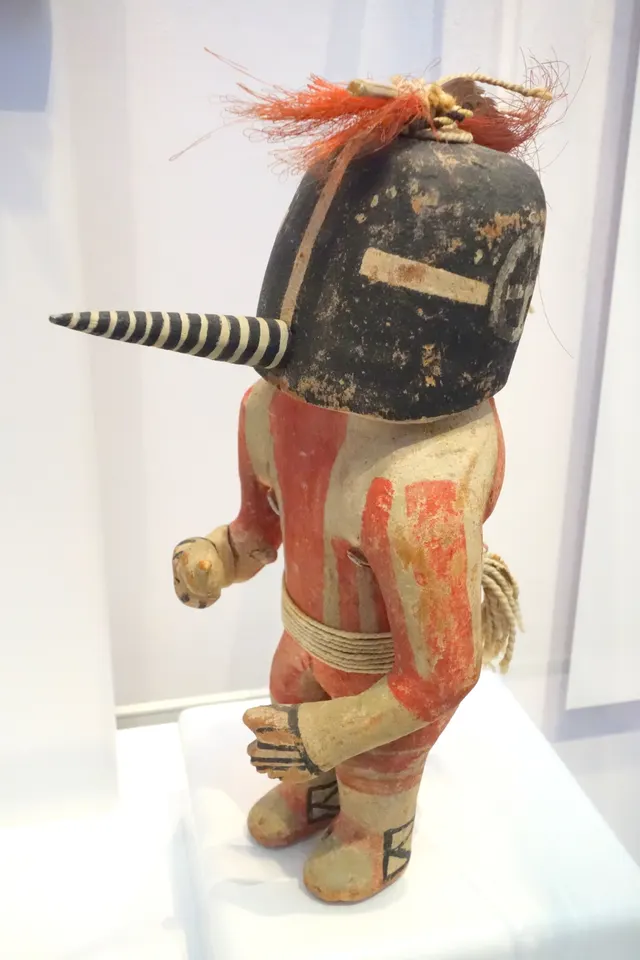
Katsina (kachina) — carved spirits of the Hopi
Among the Hopi and other Pueblo peoples of the American Southwest, katsinam (singular katsina; often anglicised “kachina”) are supernatural beings that embody rain, animals, plants and ancestral spirits — more than 400 of them in the Hopi pantheon. Carved from cottonwood root and painted, katsina dolls (tithu) are given to children not as playthings but as teaching aids, to help them learn and remember the spirit world.
Collectors note a distinction: “katsina” properly refers to figures made by Puebloan people themselves, while “kachina” is often used for those made by others.
Corn-husk dolls
Many Northeastern nations, including the Haudenosaunee (Iroquois), made dolls from dried corn husks. Famously, many are made without a face — a tradition explained by a teaching story in which a beautiful husk doll grew vain about her reflection and lost her face as a gentle lesson.
American icons: Kewpie, Raggedy Ann & Barbie
The Kewpie began as cherubic cartoon characters drawn by illustrator Rose O’Neill in 1909, first produced as bisque dolls in Germany from 1912. Raggedy Ann, the red-yarn-haired rag doll, was created by writer Johnny Gruelle around 1915 and made famous by his 1918 Raggedy Ann Stories.
In 1959, Mattel’s Barbie — conceived by Ruth Handler and modelled on the German Bild Lilli figure — introduced the adult-figured teenage fashion doll; some 300,000 sold in the first year, and the doll reshaped the global toy industry.
Frequently asked questions
What is the difference between a katsina and a kachina doll?
They refer to the same carved Hopi figures. “Katsina” is the linguistically correct Hopi term (there is no “ch” sound in Hopi), while “kachina” is a common anglicised spelling that arose from early mishearings; it is often used for figures made by non-Puebloan people.
Why do some corn-husk dolls have no face?
A Haudenosaunee (Iroquois) teaching story tells of a beautiful corn-husk doll who grew vain about her reflection and lost her face — so many are made faceless as a reminder against vanity.
Sources & further reading
Written in our own words from the references above and other reputable sources. Cultural traditions vary locally and scholarship evolves; corrections are welcome via our contact page.