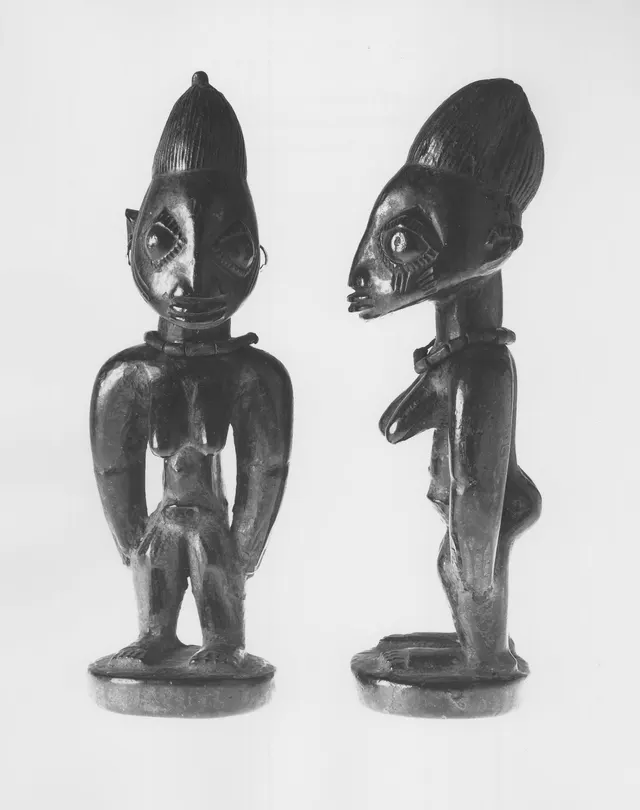
The Yoruba people of Nigeria hold twins in extraordinary esteem, and from that reverence comes one of Africa’s most moving doll traditions: the ère ìbejì, a small carved figure that becomes the earthly home for the spirit of a departed twin.
Ère ìbejì — “image of the twin”
The name breaks down as ère (sacred image), ibi (born) and eji (two) — “image of the one born two.” When a twin dies, the family commissions a single carved figure; if both die, two are made. The figure is understood as a focal point for the spirit of the deceased twin, who is believed to live on in the spirit world.
Cared for like a living child
The ère ìbejì is not shut away. It is ritually washed, fed, dressed and carried in a cloth on the mother’s back, exactly as a living baby would be. Figures are often rubbed with red camwood powder and indigo, and adorned with strings of beads and cowrie shells — the marks of love and attention accumulating over years.
Not a child, but an ideal
Strikingly, an ère ìbejì does not look like an infant. It is carved as an idealised adult in the prime of life, reflecting Yoruba ideals of beauty and dignity — because the spirit it honours is imagined not as it died but as it might have flourished.
Twins & the thunder god
The Yoruba have among the highest twinning rates in the world, and twins are seen as blessed, born under the protection of the òrìṣà Shango. Since the 1970s some families have used manufactured dolls or photographs in place of a carved figure, but the caring impulse behind the tradition endures.
Frequently asked questions
What is an ère ìbejì figure?
An ère ìbejì is a Yoruba carved wooden figure that honours a twin who has died, serving as a home for the twin’s spirit. The name means “image of the one born two.”
How are ibeji figures cared for?
They are ritually washed, fed, dressed and carried on the mother’s back like a living baby, and often adorned with camwood powder, beads and cowrie shells.
Sources & further reading
Written in our own words from the references above and other reputable sources. Cultural traditions vary locally and scholarship evolves; corrections are welcome via our contact page.