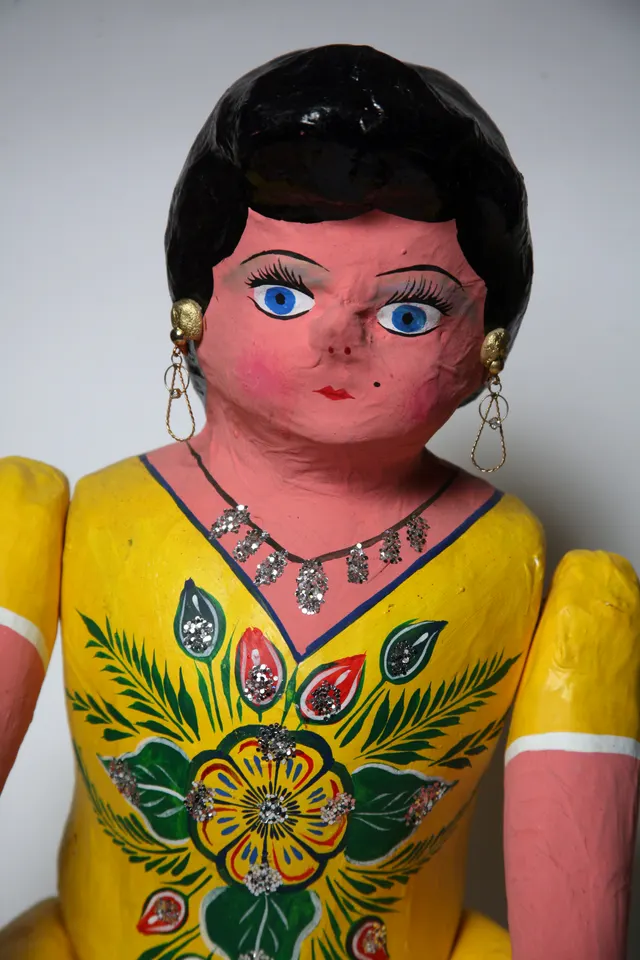
The dolls of Mexico and Central America are folk art at its most joyful: hand-shaped, hand-painted and vividly coloured. Several are so beloved they have become emblems of national identity and heritage craft.
Lupita — the cartonería doll
Lupita dolls are made from cartonería, a very hard papier-mâché, a tradition roughly two centuries old in central Mexico. They arose as an affordable substitute for costly imported porcelain dolls and stayed popular until plastic dolls took over in the later twentieth century. Traditional Lupitas are painted with bright Otomí-style flowers and are now made largely by artisan workshops in the city of Celaya as collectors’ pieces.
María — the Otomí rag doll
The cloth “María” doll, with its round face, ribboned braids and layered skirt, comes chiefly from the Otomí (Ñäñho) communities of Amealco in Querétaro. Though the modern form is often traced to a 1970s effort to support local artisans, the María has become one of Mexico’s most recognisable cultural icons — even honoured on a postage stamp and in giant public sculptures.
Guatemalan worry dolls
From the highland Maya of Guatemala come tiny worry dolls (muñecas quitapenas), made of wire, wool and scraps of traditional textile. A child tells each doll a single worry at bedtime and tucks them under the pillow, so the dolls may carry the troubles through the night. Tradition links them to a Maya legend of a princess, Ixmucané, gifted the power to solve any human worry.
Frequently asked questions
What is a Lupita doll?
A Lupita is a Mexican doll made of cartonería (hard papier-mâché), a tradition about two centuries old. It arose as an affordable substitute for imported porcelain dolls and is painted with bright Otomí-style flowers.
How do Guatemalan worry dolls work?
A child tells each tiny worry doll (muñeca quitapenas) a single trouble at bedtime and tucks them under the pillow, so the dolls may carry the worries away through the night.
Sources & further reading
Written in our own words from the references above and other reputable sources. Cultural traditions vary locally and scholarship evolves; corrections are welcome via our contact page.